
Written by Winston Szeto
Edited by Amy Wang
I’m a man in my mid-40s, with seven years in the journalism industry. Having overcome numerous life challenges on my own — including school bullying, immigration and unemployment — I long believed that connecting with a wider community was nice to have, but not essential.
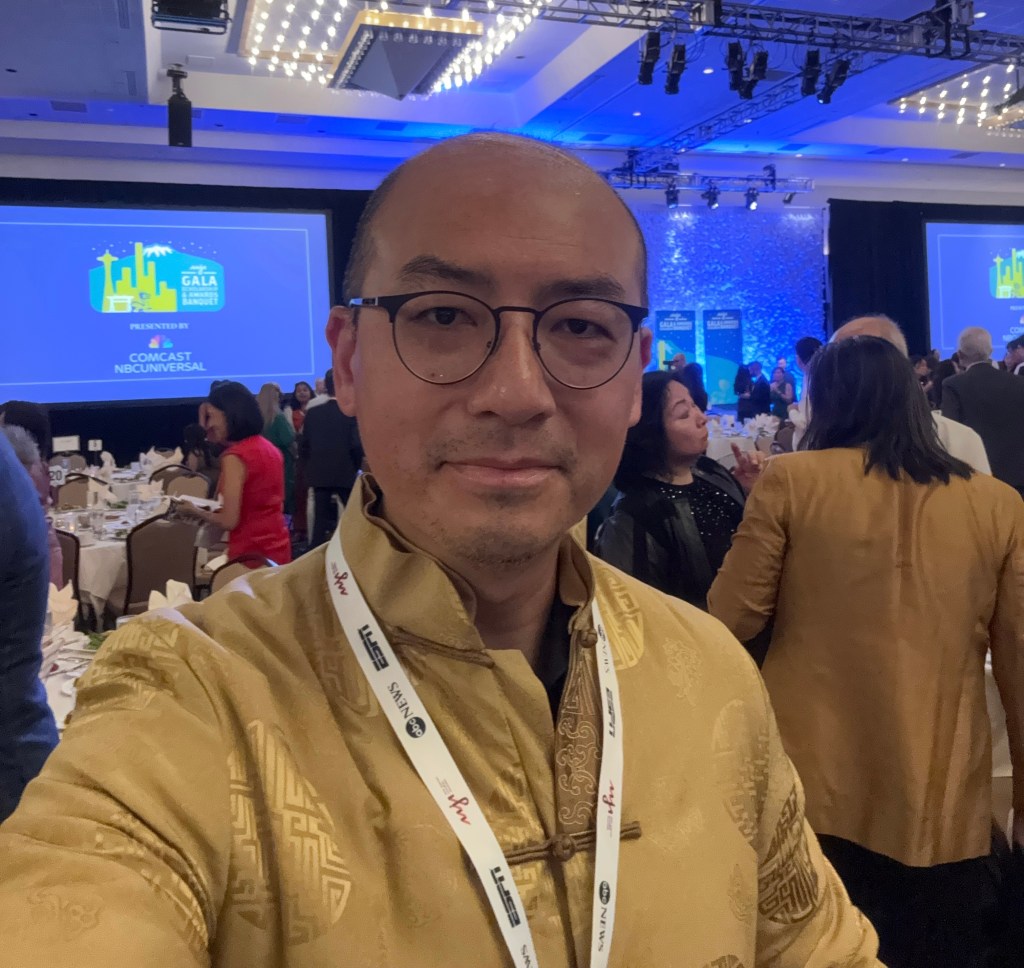
In recent years, my attitude began to shift. And after attending the Asian American Journalists Association’s annual convention for the first time in Seattle this summer, I came away with a stronger belief in the power of being part of a community that shares similar backgrounds with me.
How it started
My AAJA journey didn’t start in the U.S., but in Canada. While working as a digital writer at the Canadian Broadcasting Corporation in Kelowna, British Columbia, I joined AAJA as a professional member. I paid the membership fee out of my own pocket, without the corporate sponsorship I receive from my current employer.
This was just months after I had shown public support for Michelle Li of KSDK in St. Louis. In 2022, she revealed she had received a voicemail accusing her of being “very Asian” for discussing Korean food during a TV segment on New Year’s Day meals. I expressed solidarity on Twitter (now X, a platform I haven’t posted on for almost two years) and even bought two “Very Asian” T-shirts from the U.S. I have to admit, those shirts earned me some compliments from baristas and restaurant servers in Canada.
Being part of a wider community of Asian journalists, even from afar, helped me sustain my courage and commitment to telling immigrant stories in British Columbia. That was especially important in a newsroom that was predominantly white (and has become even more so since I left for Oregon), where I had no leaders of color to look up to as role models.
How it’s going
I continued my AAJA membership after moving to Portland two years ago. Thanks to Oregon Public Broadcasting’s sponsorship, I was able to renew my membership and attend the AAJA convention for the first time.
I had visited Seattle many times before — for sightseeing, shopping and great Asian cuisine — traveling from British Columbia or Oregon over the past seven years, except during the pandemic. But this time, the convention added a new depth to my stay in the city.
Without the AAJA convention, I wouldn’t have dined at Tai Tung Chop Suey — the 90-year-old Chinese restaurant once frequented by Bruce Lee — with veteran Asian American journalists, exchanging stories and experiences.
Without the convention, I wouldn’t have shared with fellow Asian American journalists what it was like to be the lone first-generation Asian immigrant journalist in my Kelowna newsroom, breaking multiple glass (or bamboo) ceilings to find my place in this industry.
Without the convention, I wouldn’t have watched the screening of Lucy Liu’s “Rosemead” and attended the fireside chat at the gala, where I connected deeply with the idea that immigration is a form of trauma for many in Asian American communities. I realized that my own move — leaving my birthplace, disrupting my career and enduring a long stretch of unemployment — was indeed a trauma I had worked hard to overcome.
At a time when DEI is under attack and immigrants face growing hostility in the U.S., the gala’s keynote reminded me why journalism matters: Covering underrepresented communities isn’t window dressing — it’s democracy in action.
Earlier this year, I joined the AAJA Portland Chapter board to give back to the Asian American journalist community. At the convention, I shared my story and professional experiences with journalism students while hosting the Think Public Media booth, grateful for the journalists — including many journalists of color — who once gave me the support and advice I needed as a newcomer.
Whether you’re a J-school student or a longtime AAJA member, I hope to see you at the AAJA’s convention in Minneapolis next June.
 AAJA Portland